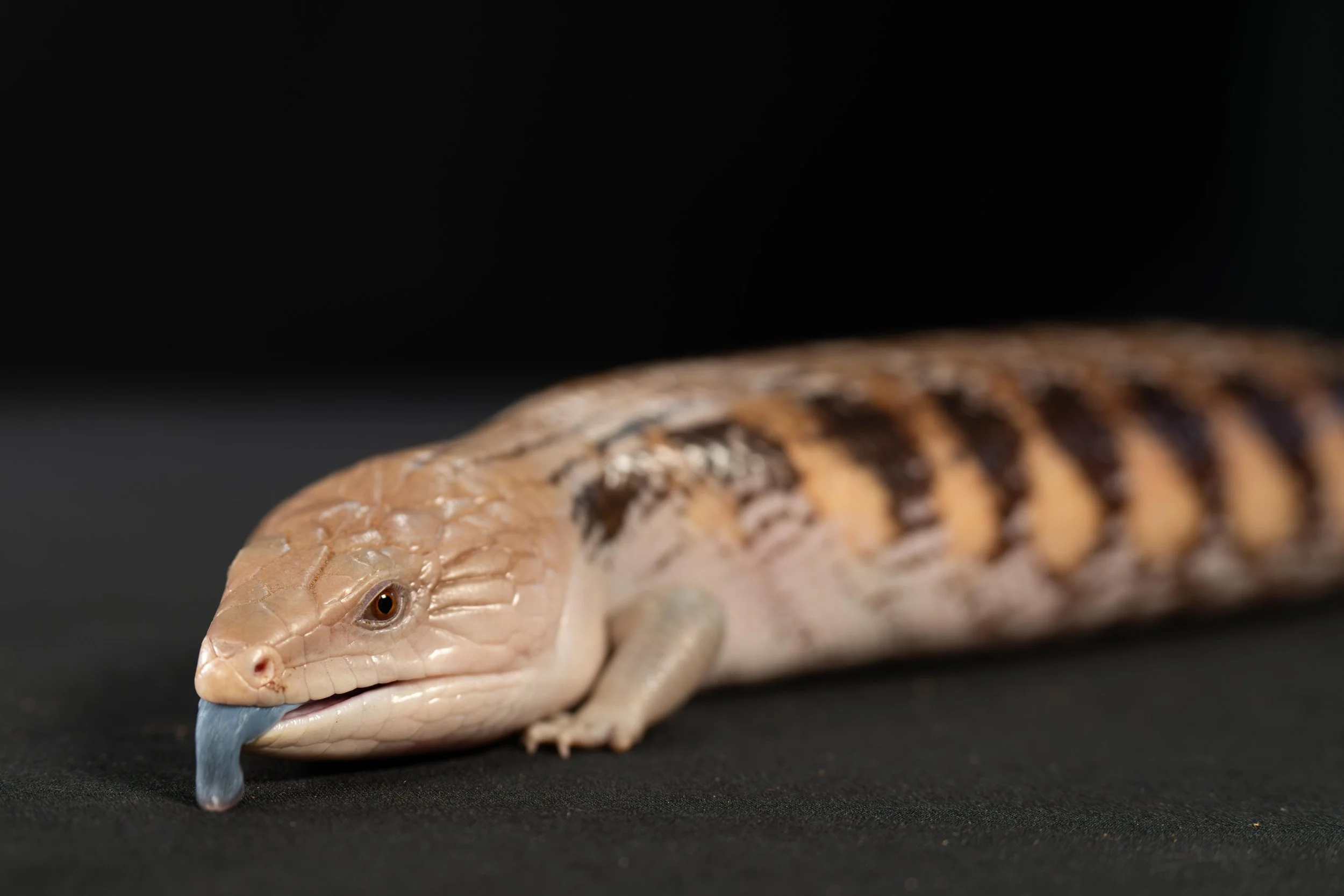

Northern Blue-tongued Skink
Tiliqua scincoides intermedia
1. General Information
Names and family. The northern blue-tongued skink is a subspecies (a distinct regional form) of the common, or eastern, blue-tongued skink, Tiliqua scincoides. It belongs to the skink family, Scincidae.
Appearance. This heavy-bodied lizard has short legs, smooth scales and a bright blue tongue. Its pale yellow-brown to grey back has cross-bands, and its sides show yellow or orange bands. Males usually have a shorter body but a longer tail, legs and head than females.
Size and weight.
Head-and-body length (snout-to-vent length): up to about 37 cm (14.6 in)
Total length: averages about 45 cm (18 in), up to about 56 cm (22 in) in zoo records
Weight: about 280–510 g (10–18 oz) per zoo figures; wild Northern Territory adults in one study averaged about 590 g (1.3 lb)
Sources vary, so treat these as approximate.
Lifespan. Wild lifespan is unknown. Captive northern blue-tongues have lived at least 12 years, and zoos report about 15 years in human care.
Diet. It is an omnivore (it eats plants and animals), taking plants, insects, other invertebrates and small vertebrates. It especially relishes snails.
Reproduction. Blue-tongues are viviparous: they give birth to live young. Mating takes place in the dry season (August–September). Up to about 10 babies are born three to four months later, at the start of the wet season.
Behavior. This ground-dweller is mostly active by day, sometimes at night in hot, humid weather. In the dry season it slows down and rests in burrows. Each uses a home range of 2–12 hectares (5–30 acres), often returning to the same sleeping spot.
2. IUCN Conservation Status
Global (whole species). The IUCN Red List does not assess the northern subspecies separately; its assessment covers the whole species, Tiliqua scincoides, which is listed as Least Concern (assessed 2017) with a stable population trend. “Least Concern” means the species as a whole is not currently considered at risk of extinction. The assessment names invasive cane toads as the main threat, “especially for the northern Tiliqua scincoides intermedia,” and says this form “may be experiencing population declines.” It lists no specific conservation actions beyond protected areas.
Regional (Australia). Australian listings assess the northern subspecies alone, so they can differ from the global rating:
Federal (EPBC Act): Critically Endangered since December 2023
Western Australia and Queensland: Critically Endangered
Northern Territory: the federal database shows no NT listing
Skinks die after eating poisonous cane toads, which now cover about 91% of this skink’s range, and monitored sites have recorded declines of more than 95%.
Conservation efforts include keeping islands toad-free, managing fire and feral animals, protecting shady habitat and training skinks to avoid toads.
Pet trade. Australia has banned commercial export of live native reptiles since 1982. Overseas breeders often say their stock descends from pre-ban exports, but researchers note this is hard to confirm because smuggling continues. The subspecies has been listed on CITES Appendix III, an international trade-monitoring list, since 2022.
3. Habitat and Geographic Range
Native range. This skink is found only in northern Australia. Its range runs from Eighty Mile Beach in Western Australia, across the Kimberley and the Top End, to about Cloncurry in western Queensland. It also lives on islands such as Melville and Groote Eylandt. Blue-tongues on Cape York Peninsula belong to the eastern subspecies.
Habitat and climate. It lives in the wet-dry tropics, where most rain falls in a few summer months, in savanna woodland, monsoon forest, gorges, swamps, floodplains and gardens.
Using its environment. GPS tracking showed that these skinks spend about 95% of their time in small, shady, damp thickets. At one site, the highest temperatures in these thickets averaged 43 °C (109 °F), compared with 57 °C (135 °F) nearby.
Native vs. introduced. The IUCN assessment records no introduced range for the species.
4. Fun Facts
In several Kakadu languages it is kurri; in the southern Kimberley, lungkura.
At least 33 adults used one 5-hectare (12-acre) patch of riverside scrub during one study.
Scientists fed skinks “toad sausages” laced with a nausea-causing chemical; trained skinks survived the toads’ arrival, while most untrained ones died.
The tongue’s color peaks in ultraviolet light, which is invisible to people.
Near a predator, tested skinks exposed more tongue even while tongue-flicking.
5. Remarkable Design Features
A Startling Blue Tongue. When attack is imminent, the skink gapes, flashes its tongue and hisses. The tongue’s hidden rear is about twice as bright as its tip, and the skink saves this display for the final moment, which may startle a predator. The display is shared across Tiliqua; its precise timing reflects a Creator whose wisdom extends to behavior.
Bony Armor. Its scales contain small bone plates called osteoderms, which help protect adults from bites. In T. scincoides, the osteoderms on the head also help carry biting forces. The same structure provides both protection and strength.
Shell-Crushing Jaws. Large teeth and strong jaw muscles crush snail shells and beetles, equipping a slow lizard for slow prey: a fit between body and lifestyle that speaks of thoughtful design.
A Pantry in the Tail. The tail stores fat for times of drought. A grabbed tail can break off and regrow, so one body part serves as both food store and escape route, an economy that reflects God’s creativity.
Live Birth with a Placenta. In T. scincoides, embryos are nourished with help from a placenta, an organ that supplies oxygen and removes waste. Newborns fend for themselves immediately, and births are timed to the wet season, which is careful provision for new life.
6. Biblical Worldview Connection
The facts above are scientific observations; what follows is biblical reflection. Scripture says God made “everything that creeps on the ground according to its kind” (Genesis 1:25, ESV). The psalmist praises Him: “O LORD, how manifold are your works! In wisdom have you made them all” (Psalm 104:24, ESV). Scripture also teaches, “Whoever is righteous has regard for the life of his beast” (Proverbs 12:10, ESV). Caring for this threatened skink honors its Maker.
7.